
Hyundai’s New Truck Patent Reveals a Feature That Electric Pickup Fans Will Love
 Daryl Williams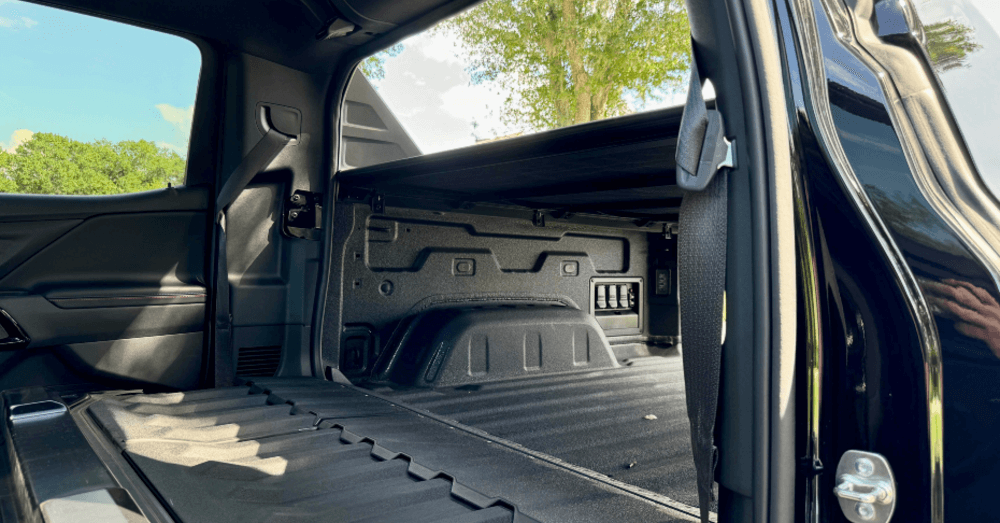
Hyundai is cooking up something big for the American truck market, and a recently discovered patent points to a feature that made the Chevrolet Avalanche a cult favorite. The Korean automaker’s upcoming body-on-frame pickup could include a midgate, and if you’ve ever tried to haul lumber or kayaks in a short bed, you know exactly why that matters.
- Hyundai filed a patent for a midgate water drainage system, suggesting their upcoming US-market truck will include this cargo-extending feature.
- The midgate design was popularized by the Chevrolet Avalanche and recently returned on the electric Silverado EV, where it extends bed length to nearly 11 feet.
- Separate Hyundai patents covering battery protection systems hint that their new truck may offer electrified powertrains, possibly including an extended-range hybrid option.
What Exactly Is a Midgate and Why Should You Care?
Picture this: you’ve got a 10-foot ladder and a 6-foot truck bed. Most people either leave the tailgate down with a red flag flapping in the wind, or they spend money renting something bigger. A midgate changes the equation entirely.
A midgate is simply a panel that opens between the truck bed and cabin, letting cargo extend through the back of the cab. Fold down the rear seats, open that panel, and suddenly your modest bed becomes a cargo-hauling machine. Chevrolet’s Avalanche made this famous back in 2001, and loyal owners still talk about it like a lost friend.
Chevy revived the concept with the Silverado EV, and the numbers speak for themselves. That truck goes from a 5-foot-11-inch bed to over 9 feet with the midgate open. Drop the tailgate too, and you’re looking at nearly 11 feet of usable space. For an electric truck where every inch counts, that’s a pretty smart workaround.
Reading Between the Patent Lines
Hyundai’s patent focuses on something fairly mundane: water drainage. Specifically, it describes how a midgate’s seals would channel water away from the cabin. Engineers proposed using holes in the seals that guide moisture through the lower partition and out through the floor.
By itself, a drainage patent isn’t exactly headline news. But here’s the thing: Hyundai doesn’t currently sell any vehicle with a midgate. So why patent drainage solutions for something you don’t make? The answer seems obvious.
Right now, Hyundai’s only truck in America is the Hyundai Santa Cruz, a compact pickup running on a unibody platform shared with the Tucson. It competes with the Ford Maverick in the small truck space. But Hyundai confirmed back in September that they’re building a different animal altogether. A real body-on-frame truck aimed at the Tacoma, Colorado, and Ranger crowd is coming before 2030.
The Electric Connection
Here’s where things get interesting for EV enthusiasts. A separate patent filing from Hyundai describes a drainage system specifically designed to protect power electronics and battery components under a truck bed. It uses water-blocking walls around electrical components with designated drainage areas to keep everything dry.
Hyundai Australia CEO Don Romano dropped some hints during a recent media event, calling the upcoming truck “mind-blowing” and mentioning an unconventional hybrid setup. He described it as “not necessarily a plug-in hybrid, but a different type of hybrid.” That sounds a lot like an extended-range electric vehicle, where a small engine generates electricity for the motors rather than driving the wheels directly.
This approach could give Hyundai a real advantage. Midsize trucks aren’t known for fuel efficiency right now. Your best option is Toyota’s hybrid Tacoma, tuned for performance rather than fuel economy at just 23 mpg combined. A well-executed EREV could offer both the range anxiety-free driving of a traditional truck and the torque-heavy experience that makes electric pickups so fun to drive.
What This Means for Truck Buyers
Hyundai has proven they can break into markets where nobody expected them. Their crossover lineup carved out space against established competition, and a midsize truck with a midgate could follow the same playbook.
A midgate makes particular sense for buyers who occasionally need extra hauling capacity but don’t want a full-size truck taking up their driveway. With tonneau covers in place, it also creates weatherproof storage, turning the bed into a secure compartment.
Patience will be required. We won’t see this truck until sometime before 2030, and Hyundai hasn’t confirmed final specifications. Patents don’t always become production features either. But a practical cargo solution paired with battery-friendly engineering suggests Hyundai is thinking seriously about what truck buyers actually need.
For now, the midgate remains most accessible on the Silverado EV, where it costs around $95,000 to get one with all the features. If Hyundai can deliver something similar at a lower price point with strong efficiency numbers, the established players might finally have real competition on their hands.